


Material Comparison: Bone China Bowls vs. Porcelain Bowls – Which is Better for Your Dining Table? (Pros & Cons Analysis)
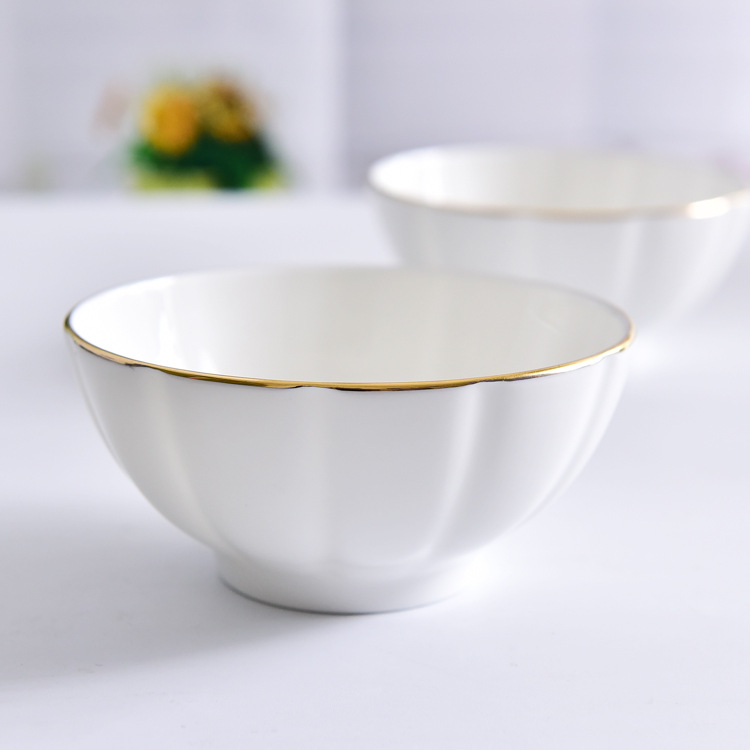
Bone China and standard porcelain bowls are two of the most popular materials for dinnerware globally. Both offer excellent functional and aesthetic qualities, but they possess distinct differences stemming from their composition and firing processes.
Choosing the right material for your dining table—whether for everyday use or high-end formal dining—depends heavily on your personal aesthetic preferences, usage needs, and budget.
Here is a detailed pros and cons analysis comparing Bone China and Porcelain bowls.
Deep Dive: Bone China Bowls
Bone China is a type of soft-paste porcelain that incorporates bone ash (typically bovine bone) into its clay composition.
Key Features and Advantages (Pros)
| Feature | Detail | Benefit |
| Translucent Elegance | The addition of bone ash gives Bone China a unique translucency when held up to the light. | Offers a delicate, high-end, and exquisite appearance ideal for luxury settings. |
| Lightweight and Thin | It is typically lighter and can be manufactured thinner than standard porcelain. | Easier to handle, stacks efficiently, and maintains a refined feel. |
| Uniform Texture | The texture is incredibly smooth and uniform, contributing to its refined finish. | Excellent canvas for detailed decoration and high-quality glazing. |
| Durability (Surprisingly) | Despite its delicate look, high-quality Bone China is very durable and chip-resistant. | Suitable for use, though often reserved for special occasions. |
Disadvantages (Cons)
- Higher Price Point: Bone China is generally considered a premium product due to the cost of raw materials and complex firing process, making it more expensive.
- Thermal Performance: Because it is thin, Bone China has relatively better thermal conductivity, meaning it may not retain heat as long as a thick porcelain bowl.
Deep Dive: Porcelain Bowls (Standard Ceramic)
Porcelain is the umbrella term for high-fired ceramic, usually composed of clay, feldspar, and quartz. Standard porcelain offers incredible versatility in design and function.
Key Features and Advantages (Pros)
| Feature | Detail | Benefit |
| Superior Durability | Standard porcelain is very sturdy and less prone to chipping or breakage from everyday knocks. | Highly practical and durable for daily family use or high-volume commercial environments. |
| Aesthetic Versatility | Available in a vast array of finishes, from glossy glazes to rich matte textures. | Offers more diverse design and stylistic choices to match different decors. |
| Better Thermal Mass | Thicker porcelain bowls have poor heat conductivity, giving them superior thermal mass. | Can be more effective at keeping contents (like soups or oatmeal) warm for longer. |
| Wide Price Range | Due to the varying grades and manufacturing processes, porcelain has a broad and accessible price spectrum. | Offers cost-effective options without sacrificing quality. |
Disadvantages (Cons)
- Heavier and Thicker: It is generally heavier and thicker than Bone China, lacking the same delicate feel.
- Non-Translucent: Standard porcelain is opaque and does not possess the unique translucent quality of Bone China.
Comparison Table: Bone China vs. Porcelain
| Feature | Bone China | Standard Porcelain |
| Composition | Clay, Feldspar, Quartz, Bone Ash | Clay, Feldspar, Quartz |
| Appearance | Translucent, lighter, delicate | Opaque, often heavier, sturdy |
| Texture | Very uniform and smooth | Wide variety (smooth to textured) |
| Heat Retention | Lower (due to thinness) | Higher (due to thickness/mass) |
| Price | Generally high-end and expensive | Wide range (budget-friendly to high-end) |
| Best For | Formal dining, high-end gifting | Everyday use, durability, high volume |
Which is Better for Your Dining Table? A Buying Guide
The choice between Bone China and Porcelain ultimately rests on three factors:
- Aesthetic Preference:
- Choose Bone China if you prioritize thinness, lightness, translucency, and an overall sense of formal elegance and luxury.
- Choose Porcelain if you prefer a thicker, sturdier bowl with a greater variety of colors/textures, or if your setting requires a more casual look.
- Usage Scenario:
- Choose Porcelain for daily, heavy-duty family use where impact and frequent cleaning are concerns. It is highly practical and durable.
- Choose Bone China for special occasions, entertaining guests, or as investment pieces and formal gifts.
- Budget:
- Choose Porcelain if you require a high quantity within a restrictive budget.
- Choose Bone China if the budget allows for a higher-priced, premium product.
In conclusion, both materials offer quality and appeal. Porcelain delivers on durability and versatility, while Bone China excels in elegance and lightness. Your ideal choice is the one that best aligns with your dining environment and priorities.


